
Predicting the drag of heterogeneous rough surfaces remains a topic of great discussion as the economic and environmental impact is high. Due to incomplete knowledge on the effects of roughness in turbulent flows, this leads to inaccurate drag predictions on localized biofouling on ship hulls and ice accumulation on aircraft wings, for example.
Although simplifying assumptions have worked reasonably well for homogeneous rough surfaces, they do not hold for many heterogeneous rough surfaces as the flow conditions required to obtain the roughness function are not met. Therefore, we investigate the influence of heterogeneous rough surfaces in simplified configurations, such as a checkerboard arrangements of coarse and fine sandpaper, emulating the surface roughness.
To tackle this problem, experiments and direct numerical simulations (DNS) of turbulent channel flow will be conducted these simplified surfaces, and the results will be compared. The comprehensive dataset will provide an avenue to improve predictive frameworks for drag induced by heterogeneous rough surfaces.
In the experiment, pressure measurements will identify the pressure drop along the channel, as well as optical flow measurements using a more recently developed experimental technique, Shake-The-Box 3D Lagrangian particle tracking, will provide velocity field information. The corresponding DNS will be performed on state-of-the-art GPU-accelerated supercomputers.
The overarching goal of this project is to find the roughness function based on some sort of averaging procedure of those of the homogeneous counterpart of each kind of sandpaper. In other words, instead of finding a unique roughness function for the heterogeneous case, we will try to discover if we come up with an equation based on the homogeneous cases only.

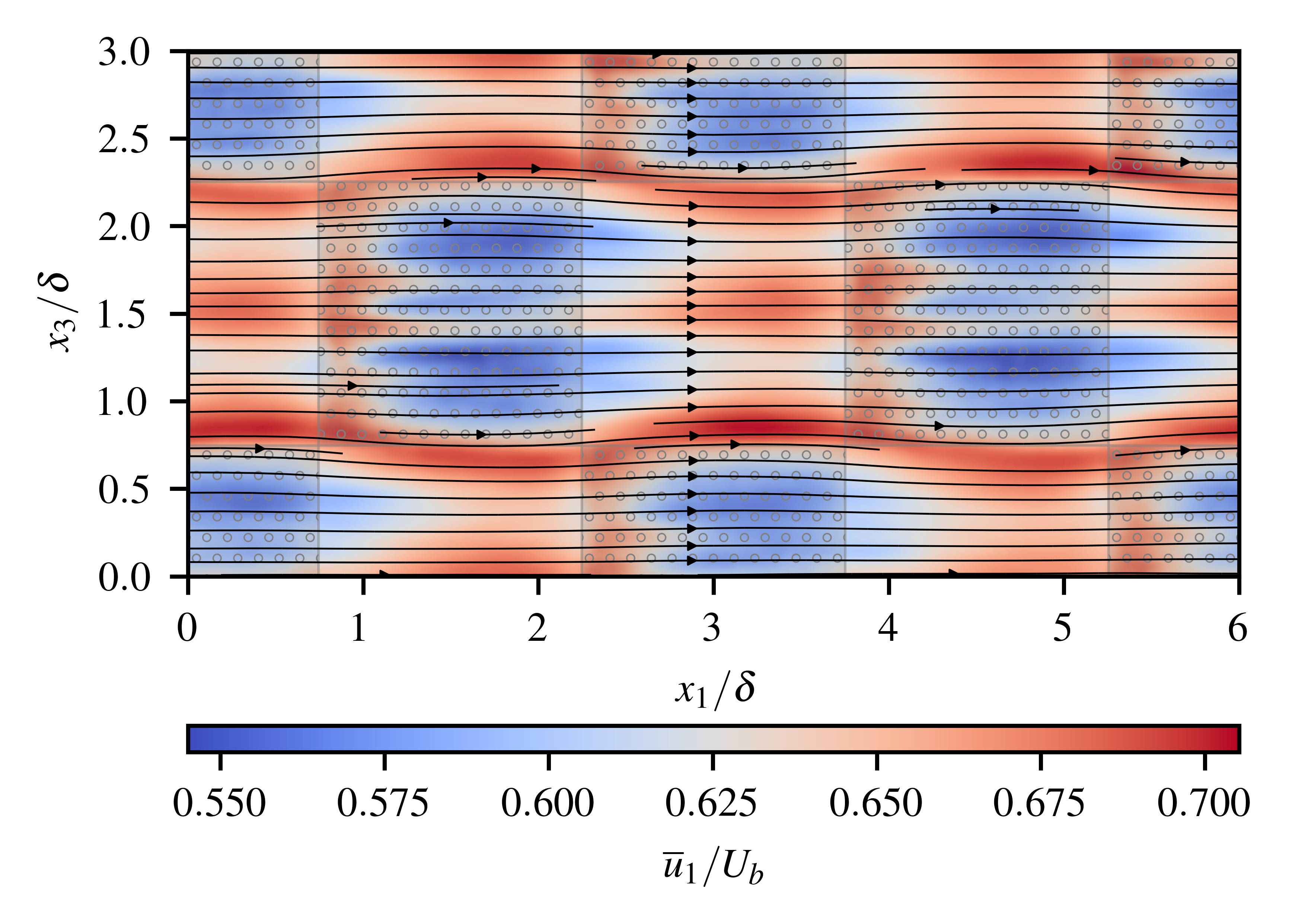
induced by the roughness patches